

Lukki Fairness Testing in Australia
How RNG testing, RTP audits and lab certificates work, what they mean for a player in Australia, and how to check Lukki Casino's credentials yourself.
A$4,000 + 300 free spins across the first four deposits · 40x · min A$20
Independent review site · we may earn a commission from the links on this page.
The short answer. Fairness testing is the independent check that a casino game's random number generator is truly random and that its advertised RTP matches what the maths pays. Australians playing online should look for two things: a lab certificate (Lukki's RNG is certified by iTech Labs) and a valid licence (Curaçao OGL/2024/164/0246).
Why fairness testing matters to a player
You cannot see inside a pokie. The reels are pictures, and the result was decided by a number generator a split second before they stopped. Independent testing is the only thing standing between that invisible maths and your balance.
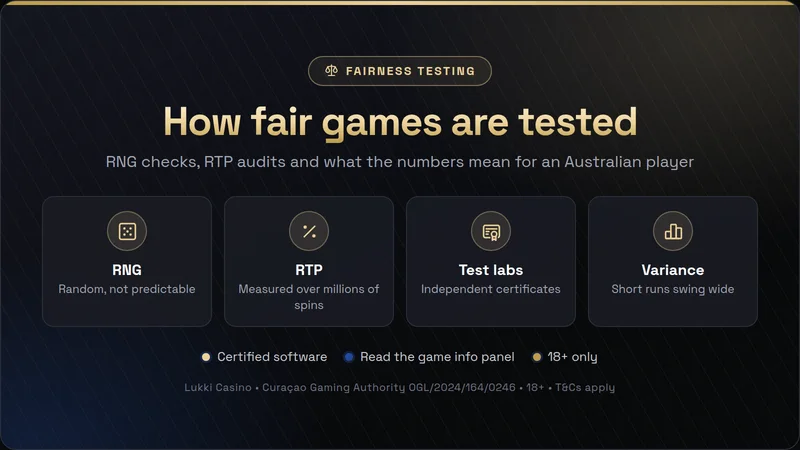
Outcomes nobody can predict
A tested RNG means the next spin cannot be guessed from the last one, by you, by the casino or by anyone watching the reels.
An RTP you can rely on
The 96% printed in a game's info panel is only worth something if a lab has confirmed the maths behind it.
Honest comparisons
When every game in a lobby is certified, you can compare pokies by RTP and volatility instead of by rumour.
A paper trail for disputes
If something ever looks wrong, a licence and a lab certificate give you somewhere to take the complaint.
For Australians this matters more than usual. Local venues are policed by state regulators, but online casinos serving Australia are all offshore, so the lab and the licence are the checks that travel with the site. Lukki Casino covers both, which is one reason I'm comfortable sending readers to Lukki's pokies lobby.
How RNG testing and RTP audits work
A lab checks two separate things: the random number generator, for patterns and bias, and the game maths, to confirm the theoretical RTP. Without that sign-off you would simply be trusting the operator.
- 1 Source and build review: the lab checks the RNG algorithm and that the version it tested is the version that goes live.
- 2 Statistical tests: millions of outputs are checked for even distribution and independence from one draw to the next.
- 3 Maths verification: every symbol combination is counted to confirm the theoretical RTP, for example 96.00%.
- 4 Certificate: the operator or studio receives a signed report and a seal that should link back to the lab.
- 5 Ongoing audits: many labs also compare real payout data against the theoretical figure over time.
A worked example: 96% RTP at A$1 a spin
RTP is a long-run average, and the long run is longer than most players think. Take a medium-volatility pokie at 96% RTP, bet A$1 a spin, and assume a standard deviation of about six times the stake per spin. The expected loss is always 4% of what you stake, but the spread around it is huge early on.
| Spins | Total staked | Expected loss | Typical result (about 95% of sessions) | Observed RTP band |
|---|---|---|---|---|
| 100 | A$100 | A$4 | −A$100 to +A$116 | 0% to 216% |
| 1,000 | A$1,000 | A$40 | −A$419 to +A$339 | 58% to 134% |
| 10,000 | A$10,000 | A$400 | −A$1,600 to +A$800 | 84% to 108% |
| 100,000 | A$100,000 | A$4,000 | −A$7,795 to −A$205 | 92.2% to 99.8% |
Swipe the table sideways to see every column.
After a hundred spins almost any result is possible, so a hot or cold evening says nothing about fairness. Only near 100,000 spins does the observed return settle close to 96%. That is why labs test millions of rounds, not one session.
The "typical result" band uses a simple normal approximation. Real pokies are lumpier: a big bonus round or jackpot can put one session far outside it. Treat the figures as a feel for scale, not a forecast.
Try the numbers: RTP and variance sliders
Move the sliders to see how RTP, stake and session length shape what you should expect. The house edge in dollars is simply total staked times (100% minus RTP).
RTP session calculator
Illustration only. Short sessions vary widely and the typical range assumes a spread of about 3, 6 or 12 times the stake per spin for low, medium and high volatility. A certified RNG guarantees randomness, not a result.
Two things jump out. Moving from 94% to 97% RTP halves your expected loss for the same play. And switching to high volatility leaves the expected loss alone but stretches the range both ways, which is why a high-volatility pokie can feel "rigged" on a quiet night while behaving exactly as certified.
Definitions: RNG, RTP, hit rate, volatility, certification
Key terms
- RNG
- Random number generator: the software that picks every outcome. A certified RNG produces results that are statistically random and independent of previous rounds.
- RTP
- Return to player: the share of all money staked that a game pays back over its full cycle. 96% RTP means A$96 back per A$100 staked on average, over millions of rounds.
- House edge
- 100% minus RTP. A 96% pokie has a 4% edge; single-zero roulette has a 2.70% edge.
- Hit rate
- How often a spin returns anything at all, often around one spin in three or four. Many "hits" pay less than the stake, so hit rate says nothing about RTP.
- Volatility
- How the RTP is distributed: low volatility pays small amounts often, high volatility pays rarely but bigger. It controls the width of your results, not the average.
- Game cycle
- The full set of outcomes a game's maths is built on. Minimum RTP rules in Australian venues are measured over this cycle, not over a night.
- Certification
- A signed report from an accredited lab confirming that the RNG and game maths meet a stated technical standard, tied to a specific software version.
Test labs and the Australian rules
A handful of labs test most of the world's casino software, and two of the big names started in Australia.
| Lab | Background | Where you'll see it |
|---|---|---|
| iTech Labs | Founded in Melbourne in 2004, part of the GLI Group since May 2023 | Online RNG and RTP certificates, including Lukki Casino's RNG |
| GLI | Gaming Laboratories International, founded in New Jersey in 1989 | Land-based machines and online games in hundreds of jurisdictions |
| BMM Testlabs | Founded in Australia in 1981, labs in Melbourne and Sydney | Australian venue machines and online systems |
Swipe the table sideways to see every column.
Pokies in Australian pubs, clubs and casinos
Venue gaming machines are approved by each state and territory, which build their rules on the Australian/New Zealand Gaming Machine National Standard. Minimum RTP is set locally: 85% in NSW and Victoria, 85% in Queensland pubs and clubs but 90% in Queensland casinos, and 87.5% in South Australia. Those are floors over the game cycle, and many machines are set above them.
Online casinos serving Australians
Online casinos cannot be licensed in Australia under the Interactive Gambling Act 2001, and ACMA blocks offshore sites rather than licensing them. So for an online player, fairness testing in Australia comes down to the lab certificate plus the overseas licence. Lukki Casino is a Curaçao-licensed site run by Just Entertainment B.V., with its RNG certified by iTech Labs, and most online pokies return more than any venue machine has to.
How to check a certificate yourself
This takes five minutes and I do it before every review. Here's the routine, using Lukki as the example.
- 1 Licence: open the Curaçao Gaming Authority validator and search for OGL/2024/164/0246. The holder should read Just Entertainment B.V. and the status should be active.
- 2 Lab seal: click the testing seal in the footer. A genuine one opens a page on the lab's own domain; an image that goes nowhere is not a certificate.
- 3 Software version: the certificate names the platform or RNG it covers. It should match the operator or supplier, not a different company.
- 4 Game RTP: open the info or paytable screen of the pokie you plan to play. Many studios release a game in several certified RTP versions, so the number in that panel is the one that counts.
- 5 Keep a record: screenshot the RTP and game version before a big session.
Studios such as Evolution, Pragmatic Play and Play'n GO have each game certified before it ships, so most titles at Lukki sit behind two layers of testing.
Provably fair crypto games
Provably fair is a different approach, popular with crypto players. Before the round, the server commits to a secret server seed by showing you its SHA-256 hash. You add your own client seed, a counter called the nonce ticks up each bet, and the result is calculated from all three. After the round the server seed is revealed, so you can hash it yourself and confirm it matches what you were shown up front.
- It proves a single round was not changed after you placed the bet.
- It does not raise the RTP: the house edge is still built into the game.
- BGaming, one of Lukki's providers, builds provably fair modes into some of its games; look for a fairness or seed panel in the game menu.
Lukki takes BTC, ETH, USDT, LTC and other coins, with crypto payouts often processed the same day. If you like checking the maths yourself, open a BGaming title at Lukki and try a verification after a few rounds.
Myths about fair casino games
Reality: a certified RNG has no memory. Each spin is independent, which is exactly what the lab tested.
Reality: the RTP lives in certified game code, not a dial turned mid-session. Only the certified version a lobby offers varies, so glance at the info panel.
Reality: that holds only across millions of rounds. A single A$100 session can end anywhere from zero to more than double.
Reality: the reels don't know bonus from cash. Wagering rules change how long you play, not the RTP.
Common mistakes when judging fairness
- 1 Judging a game on one session: a few hundred spins prove nothing either way.
- 2 Confusing hit rate with RTP: a game that "hits" every third spin can still have a lower RTP than one that feels stingy.
- 3 Trusting a seal image: if the badge does not open the lab's own page, it proves nothing. Lukki's certification comes from iTech Labs, so that's the domain to expect.
- 4 Ignoring the wagering maths: if the 40x applies to an A$100 bonus, that is A$4,000 through the reels, and at a 4% edge about A$160 of expected cost. Pick high-RTP pokies that contribute fully.
- 5 Chasing losses to "get the RTP back": the expected loss grows with every spin. Set a budget first; free, confidential help is at Gambling Help Online on 1800 858 858.
For a fixed, published edge, European roulette is the simplest case: 2.70% on every bet. Our Lukki Roulette guide walks through it, and the Lukki Casino review covers the licence, payments and welcome package.
FAQ
Is Lukki Casino fair to play from Australia?
Lukki Casino runs on an RNG certified by iTech Labs, one of the best-known independent test labs, and holds Curaçao Gaming Authority licence OGL/2024/164/0246 through Just Entertainment B.V. Fair does not mean you will win: every game still has a house edge.
How do I check a casino's fairness certificate?
Click the lab seal and make sure it opens a page on the lab's own domain (itechlabs.com for iTech Labs), not a picture hosted by the casino. Then look up the licence number on the regulator's validator, for Curaçao that is cert.cga.cw, and check the RTP in each game's info panel before you play.
Are online pokies tested against Australian standards?
Pubs, clubs and casinos in Australia run gaming machines tested against state and territory rules built on the Australian/New Zealand Gaming Machine National Standard. Online casinos cannot be licensed in Australia under the Interactive Gambling Act 2001, so offshore sites like Lukki are tested to the standard of their licensing regulator and their lab instead.
What RTP should I look for in an online pokie?
Most modern online pokies sit around 94% to 97%, while Australian venue machines only have to return 85% to 90% depending on the state. Check RTP and volatility in the game info panel.
Is provably fair better than an iTech Labs certificate?
They answer different questions. A lab certificate proves the RNG and the game maths were audited before release; provably fair lets you check each individual round yourself with the hashed server seed, your client seed and the nonce. Neither changes the RTP.
Are roulette and live dealer games tested too?
Digital roulette uses the same certified RNG as pokies. Live tables are filmed from real studios, so fairness there comes from the wheel, the dealer procedures and the studio's own licensing and audits. Our Lukki Roulette guide covers the wheels and their house edge.
Play Pokies on a Certified RNG
Lukki Casino pairs an iTech Labs certified RNG with a Curaçao licence and a welcome package worth up to A$4,000 plus 300 free spins.

By Michael Roberts, Game Testing Specialist Published · Updated · Checked